
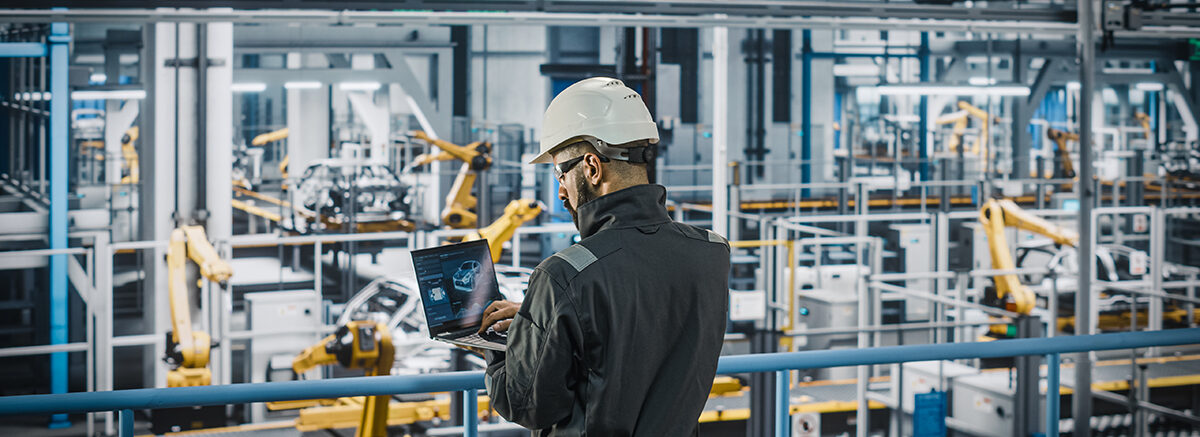
The factory floor is where innovation often shows up first, and where it’s tested the hardest. Systems are always on. Decisions happen in milliseconds. Downtime and errors carry immediate cost.
When AI fails in manufacturing, it’s usually on the production line. A model that worked perfectly in testing starts missing defects. A system designed to predict failures loses visibility. Latency creeps in. Data doesn’t arrive when it should. Productivity falls, quality suffers, and small issues quickly become operational problems.
In my conversations with manufacturers, I hear the same thing time and again: Teams can prove what’s possible in a controlled setting, but extending that capability across data centers, production systems, lines, plants, and regions, is far more difficult.
The gap between what works in isolation and what works at scale is where many AI initiatives stall, and the bottleneck isn’t what you think. Cisco’s 2026 State of Industrial AI Report shows that while 61% of industrial organizations are already using AI in live operations, only 20% have reached scaled, mature deployments. The challenge isn’t proving AI can work, it’s making it work reliably, consistently, and at scale.
The foundation for industrial autonomy
Manufacturing is moving beyond the era of isolated automation. The next phase of industrial performance is defined by autonomy, where systems don’t just execute instructions, but operate, adapt, and respond in real-time.
In this environment, the constraint isn’t the AI model itself. It’s not even the compute, which is where most AI conversations start. It’s how the entire underlying infrastructure foundation is designed. When that infrastructure can’t work together as a single, unified system, AI becomes fragile and difficult to scale.
That’s the starting point, and the problem Cisco is solving by bringing together:
- The network that moves data
- The compute that brings it to life
- The observability that makes it usable
- The security that protects it all
Why Cisco and Rockwell Automation
This is why partnerships like the one we’re building with Rockwell Automation are so important.
Together, we’re focused not just on technology, but on operationalizing AI. Rockwell’s software and control systems provide the context and domain intelligence of the factory. Cisco provides the secure, scalable infrastructure that connects and runs it all, across environments.
With platforms like Cisco Unified Edge, where Rockwell was a launch partner, we’re bringing that capability even closer to where work happens, whether that’s making quality inspection real-time, or alerting to safety issues before they happen. Check out this blog to learn more.
As Rockwell Automation CEO, Blake Moret noted in a recent conversation, “edge computing requires an integrated platform approach where the compute, the networking, and of course, the security all come together.”
From capability to production
This partnership goes beyond any single platform. It gives customers a consistent, enterprise-grade foundation to deploy AI faster, operate it reliably, and scale it across distributed environments.
Together, we’re helping manufacturers move from isolated AI pilots to production-ready capabilities that deliver real outcomes on the factory floor, whether that’s real-time quality inspection and anomaly detection, predictive maintenance driven by live operational data, or closed-loop optimization across production lines.
These are workloads where performance, timing, and reliability directly impact the business.
You can see these solutions in action at Hannover Messe 2026, where we’ll be demonstrating how AI is applied across the full production lifecycle, from design and simulation to real-time operations and predictive maintenance.
Building the future of industrial operations
Manufacturers are redefining how work gets done, not just modernizing infrastructure.
They’re evolving from reactive operations to predictive systems, from fixed processes to adaptive ones, and from automation to autonomy.
That transformation requires more than technology. It requires alignment—across domains, across systems, and across partners.
That’s what Cisco and Rockwell Automation are delivering together.
And we’re just getting started.
Visit our partnership page to explore how Cisco and Rockwell Automation are helping manufacturers move from AI pilots to production-ready outcomes.
 by admin